
Last month’s IEM Rio tournament saw 16 teams fight it out for a share of the $300,000 prize pool. The Brazilian crowd treated every round like a final, but in the end it was Team Vitality who lifted the trophy, defeating Team Spirit 3-0 in a grand final that was never really in doubt.
But what did the data tell us? We teamed up with one of our partners, DATA.BET, to analyse betting activity across one of the largest CS2 events of the season, powered by official live esports data from the GRID Data Platform. Here’s what stood out.
Live betting is doing the heavy lifting
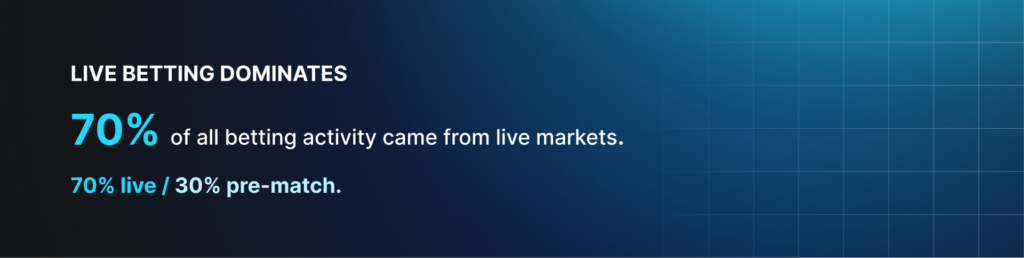
Seven in ten bets at IEM Rio were placed after the match started.
That split tells you something important: bettors aren’t making up their minds before kick-off. They’re reacting in real time, map by map, round by round, and your live data feed is what’s holding that experience together. If it’s slow or unreliable, you’re leaving volume on the table.
Two markets drove more than half of all live volume

Map Winner and Match Winner together took well over half of all live volume suggesting that when bettors are reacting in real time, they go with what they understand fastest. But the mid-tier markets also saw some action; handicap, totals, player kills, they all had takers. So, the appetite for more granular bet types is there, it just needs the product and pricing to meet it.
Operators who can price the full market stack, not just the headline markets, are better positioned to capture this audience as appetite develops.
Volume per map nearly doubled year-on-year

IEM Melbourne was the most recent comparable CS2 Tier 1 event before Rio. The per-map growth between them reflects two things running in parallel: genuine increase in bettor interest in top-tier CS2, and the specific draw of Rio as a destination event. Brazil brings crowd energy that translates into betting energy.
Home Sweet Home: The FURIA Crowd Index
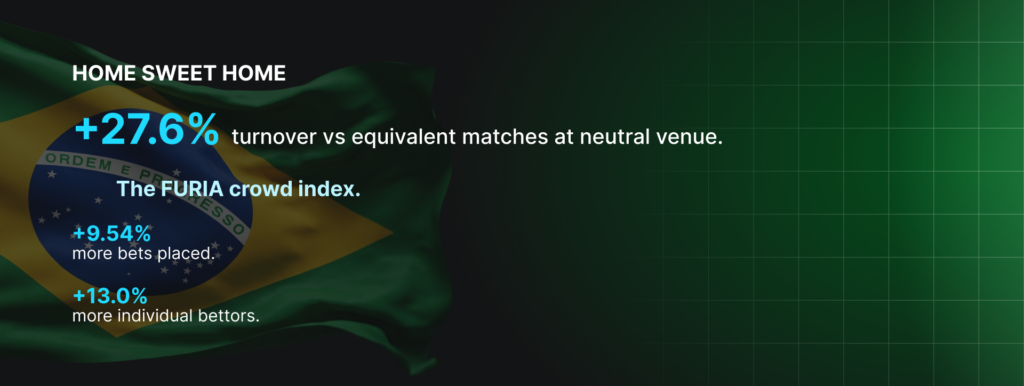
Speaking of crowd energy, compared to bracket-equivalent FURIA matches at non-Brazilian events, Rio games drew significantly more turnover, more bets, and more individual bettors.
Localised tournaments create localised betting spikes. When a home crowd is genuinely invested, that sentiment moves markets. Operators who can anticipate those dynamics, and price accordingly, stand to benefit from the surge as opposed to being caught off-guard by it.
The Chaos Number

Every kill, round result, and economy shift can move the market. At IEM Rio, odds were being recalculated thousands of times per match, averaging out to roughly once per second across the duration of each game.
That’s the operational reality of pricing CS2 in-play. The speed and accuracy of your data feed determines whether you can keep up with that pace, or whether your prices are draped in cobwebs by the time bettors act on them.
The Upset Tax
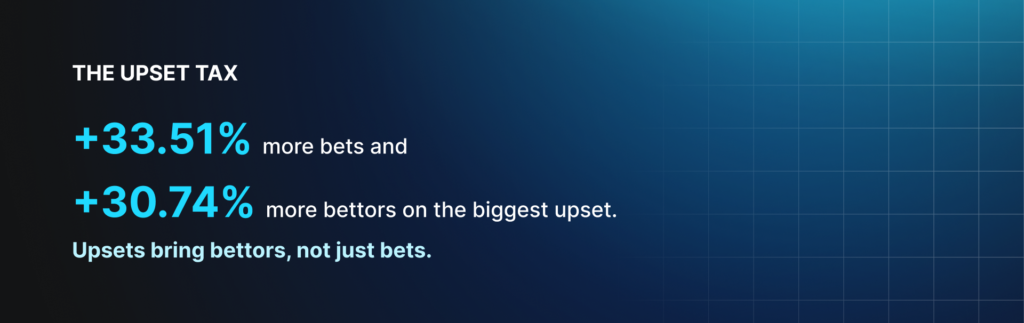
During the biggest upset of the event, participation was up substantially, but average stake size was down, meaning more people bet, but for less each.
This behaviour implies that upsets widen the funnel. They draw in bettors who might otherwise sit out a more predictable match. But those bettors are placing smaller stakes, so while the headcount is up, the money per bet is down.
That’s a different kind of volume to a high-stakes, high-confidence match, and it’s worth factoring into how you think about risk management when a fixture looks volatile before it starts. It’s not just about how much money is moving, it’s about who’s moving it.
The Market Got It Wrong
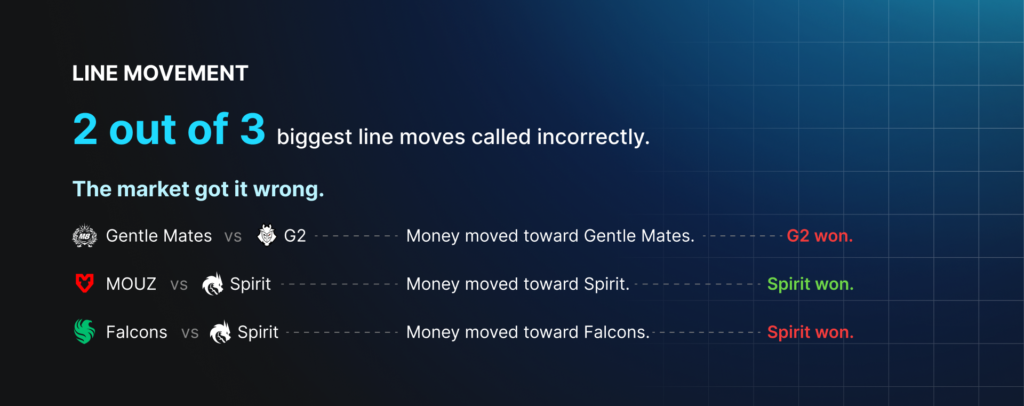
They didn’t get it wrong every time, though. Vitality were the overwhelming pre-tournament favourites and duly delivered; a 3-0 sweep in the grand final that surprised no one. But zoom out to the three biggest pre-match line movements across the event and the picture gets cloudier. The money landed on the wrong side in two out of three cases, and the matches that saw the sharpest pre-match shifts were not the ones that played out as the market expected.
Pre-match line movement in esports is not a reliable signal of outcome, at least not yet. Just because money is moving in one direction doesn’t mean you should follow it. In esports, the crowd isn’t always right, and the data will serve you better than public sentiment will.
Bet on the data
IEM Rio demonstrated that CS2 betting is growing in volume, sophistication, and behavioural complexity. Live markets dominate, crowd dynamics matter, and upsets drive participation in ways that differ meaningfully from traditional sports patterns. And the data feed is what ties it all together; if it’s not fast enough or granular enough to reflect what’s happening on the server, operators risk pricing on guesswork.
Contact our team to get fast, official, live esports data for your sportsbook, straight from the GRID Data Platform.