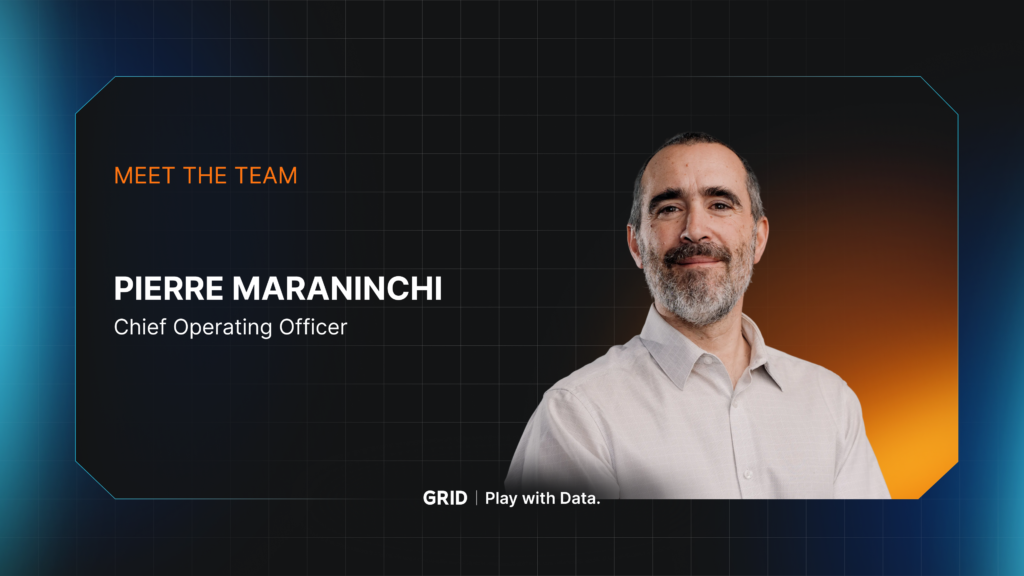
Ever wondered what operations look like inside a fast-growing esports company? We sat down with Pierre Maraninchi, GRID’s COO, to learn how curiosity, experimentation, and a few unconventional hobbies shape how he leads operations at GRID.
You’ve got a reputation for spotting challenges before they escalate. How does that forward-thinking approach shape the way you lead operations at GRID, especially when coordinating teams across operations and strategy?
I’d say a healthy dose of pessimism is actually an advantage in ops: if you’re always asking “what could go wrong,” you catch things before they become fires. I spend a lot of time engaging with other leaders at GRID, looking at industry trends, and analyzing the data we have available, because patterns tend to surface there before they do in daily operations.
The other thing I’ve learned is that operations isn’t just about making things run faster or leaner: resilience matters as much as efficiency. Whether it’s at the strategic level or in the day-to-day workflows, you need systems and teams that can absorb shocks, not just ones that are optimized for the good days.
Operations can mean very different things depending on the company. At GRID, where teams span data, products, tournaments, support, and commercial partnerships, how would you describe the role of a COO and the kind of problems you spend most of your time solving?
The way I see it, operations is fundamentally an internal support function — we’re here to make every other team more effective and reduce the friction that builds up when you have many different functions working together.
In practice, that means my role is pretty fluid: my focus shifts constantly based on where the business is going, what the commercial priorities are, and where the biggest pain points are at any given time.
But there are some recurring themes: driving a data-driven mindset across the company, ensuring our services scale as we grow without degrading the customer experience, improving how we collaborate internally through better processes, knowledge management, and automation, and investing in the next generation of leaders on the team. It’s a mix of strategic and very hands-on work, and that’s what I find most energizing about it.
GRID is a fast-evolving platform in the esports ecosystem. What are some of the biggest operational challenges you face in keeping the organization agile, and how do you tackle them?
The pace of change is the big one. We’re shipping new products and features weekly, constantly adding game titles and events to the platform, and onboarding new customers — all at the same time.
On top of that, we’re heavily dependent on game publishers, and unlike traditional sports, the “rules” in esports can change overnight — a patch, a format change, a new season structure. You just can’t assume stability the way you might in more established industries.
The other side of it is that esports is still a young industry. Some of the standards that make operations smoother in other sectors simply don’t exist yet in esports, and some of the actors we work with are still figuring things out too. So a big part of the job is building structures that are robust enough to hold, but flexible enough to adapt constantly.
You’ve transitioned from large-scale software to the esports world. What advice would you give to professionals aspiring to follow a similar path in esports or tech operations and what skills do you think are most important to develop along the way?
The most important things are curiosity and the willingness to learn, not pretending you know everything coming in. I’ve been playing video games for over 40 years, but esports was very new to me, and I had a lot to learn. Fortunately, the team at GRID was incredibly supportive, which made the transition much smoother.
Beyond that, the biggest mindset shift when moving to a smaller, faster-moving company is the level of accountability. You’re not a cog in a machine anymore — what you do has immediate, visible impact on customers and colleagues which is both exciting and scary.
You also have to get comfortable building things while you’re operating them, there’s no luxury of stepping back to design the perfect system before using it. The flip side of that is it’s much easier to experiment — new processes, new services, new automations, you can actually try things and see results quickly.
So my advice would be: embrace the accountability, develop your ability to collaborate across functions, and treat the lack of established structure as an opportunity rather than a frustration.
You love board games, and besides that, you can juggle and ride a unicycle, skills most of us can only dream of! How do hobbies like these, or other fun interests outside work, influence the way you think, problem-solve, or just unwind at the end of the day?
Cooking is my daily reset, it’s a good way to leave work behind, free my mind, and reward myself with a nice meal after a long day
Trying weird things outside of work is a low-stakes way to push yourself out of your comfort zone, pick up new skills, and have a lot of fun in the process. Last year I started doing stand-up comedy, which has been one of the most useful things I’ve done for my professional skills — it forces you to be brief, to iterate constantly based on “customer” feedback, and to get comfortable with failure in a very public way.
I think these things help you get a different perspective on things. In a world that’s increasingly shaped by platforms, social media, and AI pushing everyone toward the same references and the same mindset, having weird hobbies feels like a small act of resistance.
Look out for the next edition of Meet the Team!
If you are interested in learning more about GRID or current job openings, head to our career page.
Follow us on Linkedin and X and stay up to date with all the news from GRID.