
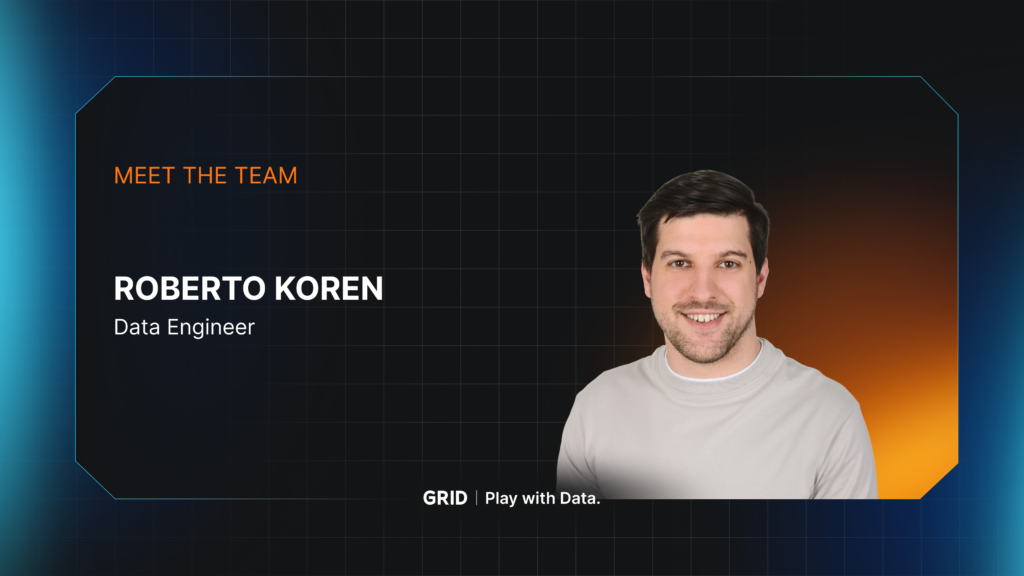
Keeping massive amounts of esports data running smoothly isn’t easy, but for Roberto Koren, Data Engineer at GRID, it’s just another day at the office. Some people collect data. Roberto turns it into solutions, automations, and the occasional excuse to dive into a new side project. Get to know the person behind the pipelines.
You came from a background in game administration and management. What drew you toward the data engineering side of esports, and what made GRID feel like the right place to make that shift?
I have been involved in esports even before I finished high school. Around my 2nd year of university, I discovered a passion for Fluid Dynamics and joined the Formula Student team to get hands-on experience with CFD, and as many can confirm, CFD simulations will provide you with a lot of data that you need to interpret and make sense of.
Around that same time, I joined GRID as a Technical Support Operator. Shortly after, our fearless leader (and current COO), Pierre, began building a new team to collect data from Support and standardize our reporting. I immediately asked if I could help and join the project, and a couple of months later, the Business Data team was officially born.
With GRID being the leader in this industry, the company culture and the challenges you face every single day, I knew that I would be doing something I love and given the fact that I would be learning something new constantly, it was an opportunity I couldn’t say no to. I can’t be thankful enough to GRID for having such amazing people and culture that allowed me to pursue this, but most importantly, to Pierre and Filipe for all the trust and help along the way.
You’re part of GRID’s Business Data team, which sits slightly differently from a traditional engineering function. For teammates who don’t work closely with business data, how would you explain what your role involves day to day and how your work supports teams across the company?
On any given day, you’ll find me handling core Data Engineering tasks, this could be anything from creating data pipelines that extract, transform, and store the data in our databases, managing and optimizing said databases or creating CI/CD pipelines.
On the other hand, as we’re tightly coupled with the other operational teams, you’ll see me taking on tasks of creating automations with Python that help operational teams do their day-to-day tasks, creating all kinds of reports or visualizations for stakeholders, managing our business systems, onboarding new joiners, creating Jira Automations, researching new Business Intelligence tools, and many more.
One of your core responsibilities is ensuring data is reliably collected, processed, and available for others to use. What kind of problems do you spend most of your time solving, and what does “good” look like when your systems are working as intended?
At GRID, we deal with massive amounts of data, so a lot of my day is spent just keeping the wheels turning smoothly. That could range from rethinking how we process our data to optimizing SQL queries and removing unnecessary JOINs. As I’m sure every Data Engineer would say, I think the universal definition of “good” for a Data Engineer is when you don’t get a Sunday morning alert that a data pipeline failed. Infrastructure that enables you to audit what happened where and when will go a long way, especially since the things most likely to break are usually external APIs we have zero control over.
You’ve been with GRID for several years as the company’s systems, scale, and tooling have evolved. How has your role grown over time, and what skills or mindset have helped you adapt to new systems and challenges?
Naturally, over time, you take on more and more responsibility. This will be anything from making sure that the systems you built are working properly to resolving issues with SQL queries. You have to embrace the new challenges, strive to learn new things, adapt to new environments and tools, have an open mind, and most importantly, good energy and good vibes.
Sometimes that Pandas DataFrame in Python will make you frustrated, and you’ll want to throw your computer out the window, but it’s all part of the journey. There’s one saying I often use that’s heavily embedded into my personality and how I go through life, through stressful and challenging times. The saying is: “It is what it is ¯\_(ツ)_/¯”.
Most importantly, don’t be scared to fail. You will have failures throughout your career, but they will teach you a lot more than quick, easy success. And if there are people who are affected by it, don’t hide the failure under the rug; inform the people who are affected by it, explain why it happened, and what solution you’re implementing so that the same doesn’t happen again.
When you’re not building pipelines or automations, whether it’s cycling through the countryside, chasing adrenaline, curating Spotify playlists, or debating whether it’s a whiskey or ice-coffee kind of day, what’s your favourite way to completely switch off?
There’s no one way, outside of what you mentioned. I love learning new things, so you’ll see me self-hosting a new piece of software I found, tinkering with tech gadgets or my car, or learning new Data Engineering or DevOps skills. As I love teaching and sharing knowledge, I also spend some of my time tutoring students at the local university.
Also, as an avid Formula 1 fan, if I’m not analyzing lap times, then I’m creating CAD models and running CFD simulations. In case the weather is nice, I’ll force my friends to go on a hike or have a BBQ, or if there’s a half-marathon happening in the area, I might go run a half-marathon. Sadly, I don’t game as much as I used to back in the day, but every so often I’ll play (the greatest video game ever) CS2 or, if I feel like torturing myself a bit, some Tarkov with the boys.
Look out for the next edition of Meet the Team!
If you are interested in learning more about GRID or current job openings, head to our career page.
Follow us on Linkedin and X and stay up to date with all the news from GRID.