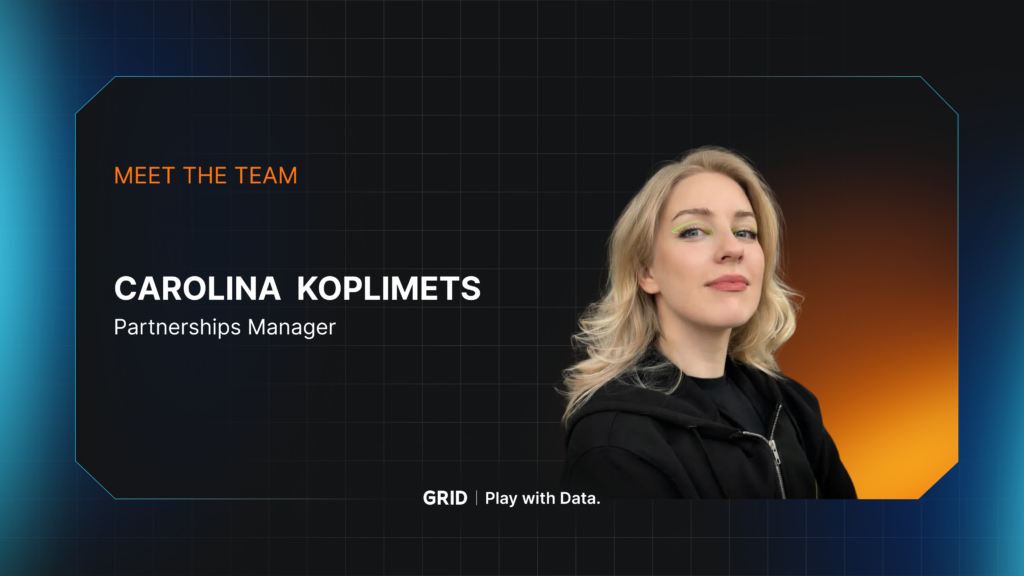
Meet Carolina Koplimets, GRID’s Partnerships Manager, who loves finding creative ways to help game developers get the most out of their data. She shares her journey from psychology to gaming, what her day-to-day looks like at GRID, and a few surprising hobbies that keep her inspired.
Your role at GRID brings together experience in gaming, user research, and data monetization. What made GRID feel like the right next step for you, and how did your background prepare you for this role?
My career path has been a bit of a journey. I worked across different industries, from industrial equipment manufacturing to user research. Over time, I realized I was looking for a place where I could truly make an impact and feel like I was building something meaningful.
When I learned about GRID, it immediately felt like a strong fit. I had worked with data and game developers before, and it’s rare to find a company operating at such an interesting intersection of games and data. On top of that, the interview process really stood out to me — people were open, positive, and clearly cared about what they were building. Joining was a very easy choice 🙂
Your role sits at the heart of GRID’s relationship with game developers. For anyone who doesn’t work directly with partners, how would you describe what you do day to day, and how your work helps developers get real value from GRID’s data?
The role has changed a lot since I joined. In the beginning, my main focus was making sure data integration projects between GRID and game developers ran smoothly. That meant coordinating between teams and ensuring everything worked as expected in the end. Over time, my responsibilities expanded to include working with tournament organizers as well, and helping to improve the day-to-day processes in our partnerships team. The end result of this is very tangible, as this helps our partners receive revenue from their game / tournament data, while GRID customers benefit from reliable, non-delayed data.
Before GRID, you worked closely with game user researchers and advised companies on monetizing data. How does that perspective influence the way you support developers now, especially when balancing product needs, data integrity, and long-term partnerships?
One thing I learned early on is that people are happy to invest in data when it is accurate (!) and reliable. In many industries, getting that level of data takes a huge amount of effort, needing to run research on actual people or develop … risky data collection systems.
In esports, the data is already there and incredibly rich, but a lot of its potential is still waiting to be used. There are so many out-of-the-box possibilities, such as creating more engaging fan experiences or making competitive achievements easier to grasp, like celebrating a player’s 100,000th kill in CS2 during the game. It’s exciting to work on making this more of a reality.
Your career blends gaming, research, and data strategy. For someone who’s early in their career and trying to find their own intersection of interests, what advice would you give about building a path that feels both intentional and flexible?
What helped me was to try not to be scared to try things that feel unfamiliar. Many interesting careers and industries only reveal themselves once you step into them! When I finished my psychology degree, I had no idea how big gaming and esports really were, and I did not even consider myself a gamer at the time. Stepping into this world completely changed my perspective, and it is now hard to imagine going back.
You are very creative, you run your own jewelry store, and you enjoy doing professional nail art. What’s one hobby or skill you have that almost never comes up at work but’s a big part of who you are?
I indeed really enjoy creating things with my hands. Since my professional work is often quite abstract, it feels really satisfying to work on something tangible and see a clear end result. One thing almost no one at work knows is that I played the piano for eight years. Lately, I have also been having fun experimenting with new instruments, like the kalimba (a type of African metallic finger harp).
Look out for the next edition of Meet the Team!
If you are interested in learning more about GRID or current job openings, head to our career page.
Follow us on Linkedin and X and stay up to date with all the news from GRID.