
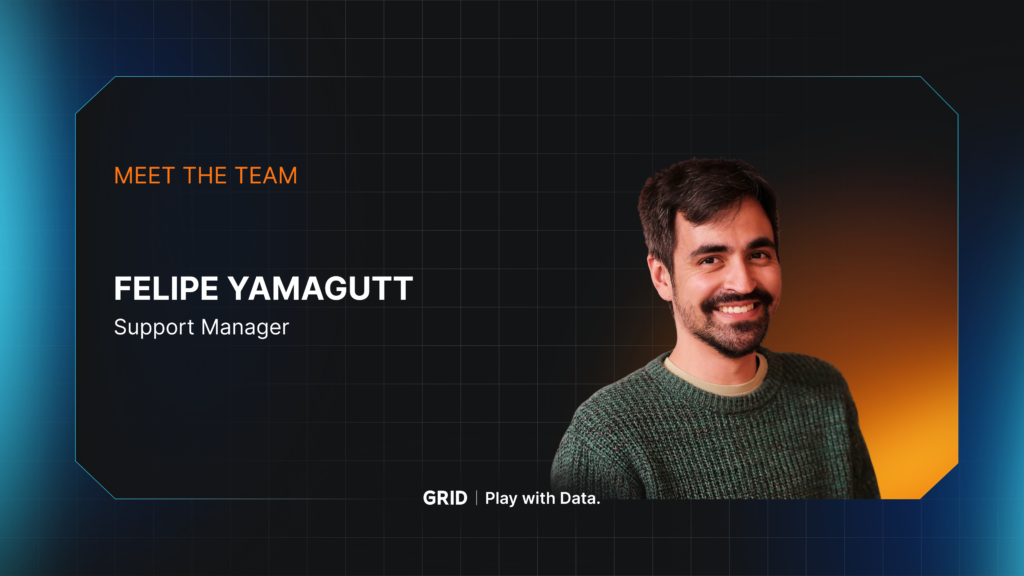
Felipe Yamagutt, GRID’s Support Manager, brings a calm, hands-on approach to one of the most fast-paced areas of esports. In this conversation, he shares how leading a global team across time zones, simplifying complex processes, and knowing when to step back instead of stepping in are key to building support that partners can truly rely on.
You’ve built your career in customer support across different countries and cultures, from Brazil to Europe, before joining GRID as a Support Manager. What made this role the right next step for you, and what excited you most about leading a support team here?
I didn’t plan a career in support, but I ended up staying in it because I like helping people and understanding how things actually work behind the scenes.
I spent a few years in iGaming before, where things move fast, expectations are high, and there’s little room for delays or uncertainty. That shapes how you see support. It’s less about answering people and more about reliability and trust.
So when I saw GRID, it felt familiar in that sense, just in a different context. Same kind of pressure, same need to coordinate between different sides, just applied to esports data instead.
Also, the remote and international setup was something I was already used to, so it wasn’t a big shift for me.
It felt like a natural continuation of what I was already doing, but with more space to take ownership and shape things.
As Support Manager, you’re responsible for both the team and the experience delivered to partners across 24/7 operations. For people who don’t see that side of the business, what does your role actually involve on a day-to-day basis?
It changes a lot depending on what’s going on.
When things are busy, it’s very operational. Following tournaments, dealing with issues as they happen, coordinating between teams, and making sure partners are not left guessing.
When things are calmer, I try to step back a bit and look at patterns. Where we’re reacting too late, where things are unclear, where we’re depending too much on specific people.
So it’s a mix of being inside the operation and then trying to make it run a bit better over time.
Managing a global support team means balancing performance, well-being, and constant availability during live tournaments. What have you learned about building a team culture that stays effective, even when everyone is working across different time zones and pressures?
The main challenge is that you’re not there for most of what happens.
People are working different shifts, picking things up mid-way, dealing with situations you didn’t see from the start. If things are not clear, it creates friction very quickly.
For me, it’s more about making things easy to follow. Clear handovers, simple communication, and making sure people don’t have to guess too much.
If the next person can pick something up without confusion, the team works.
You’ve gone from hands-on customer support to managing and developing others. For someone who wants to grow into a leadership role, what mindset shift or skill made the biggest difference in your own transition?
For me the biggest change was stepping away from doing things myself.
I used to jump-in a lot, especially during incidents, because it’s faster and you feel useful. But it also creates dependency, and over time everything starts going through you.
So I had to get used to letting the team handle things, even if it’s not exactly how I would do it, and focusing more on how they think and decide, not just on the outcome. That was probably the hardest part.
Your life story includes moving across continents, playing bass, and somehow turning everything into a spreadsheet. What’s one part of your life outside of work that people at GRID would be most surprised to learn about?
I’ve been organizing music gatherings here in Valencia. It started very casually, just friends playing together, and now it’s grown into an independent community.
It’s still pretty informal, but I like that. It’s just people showing up, playing, and connecting.
Look out for the next edition of Meet the Team!
If you are interested in learning more about GRID or current job openings, head to our career page.
Follow us on Linkedin and X and stay up to date with all the news from GRID.